
On-Page SEO
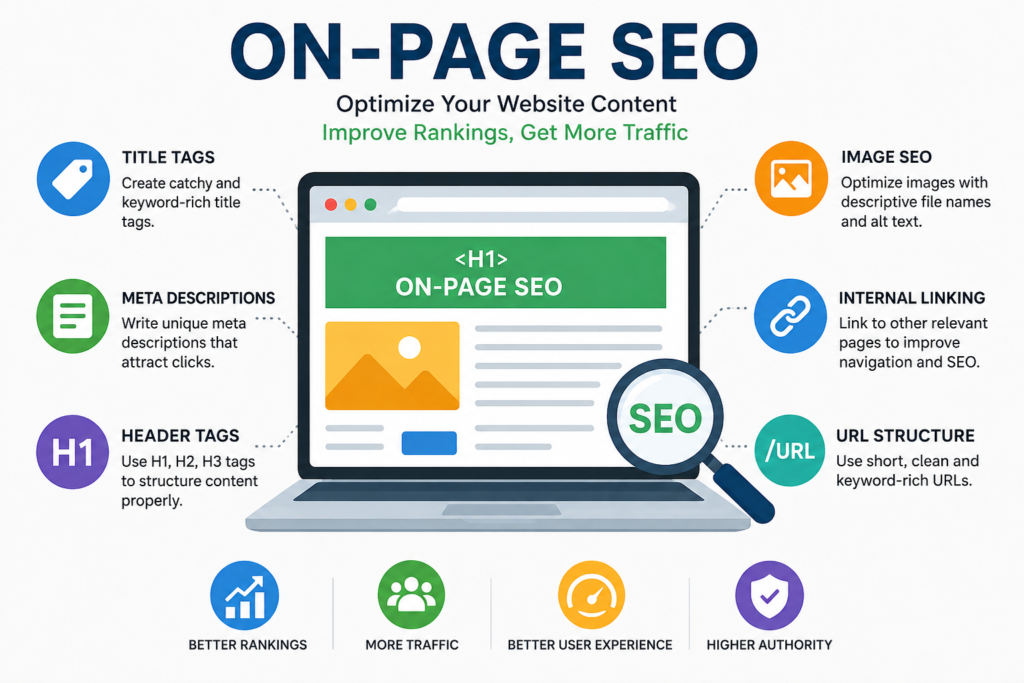
- On-Page SEO is the process of optimizing individual web pages to improve their ranking on search engines like Google. It involves optimizing content, HTML elements, keywords, images, internal links, and user experience. The main goal of On-Page SEO is to help search engines understand the content of a webpage while making it useful and engaging for visitors.
- Important elements of On-Page SEO include title tags, meta descriptions, header tags, URL structure, keyword placement, image optimization, and internal linking. A well-optimized page loads faster, is mobile-friendly, and provides high-quality content that matches user intent.
- For example, if a webpage is about digital marketing services, the keyword should naturally appear in the title, headings, URL, and content. Images should include descriptive alt text, and related pages should be connected through internal links.
- On-Page SEO is important because it directly affects website visibility, organic traffic, and user engagement. Search engines prefer websites that offer valuable and properly structured information. A strong On-Page SEO strategy improves rankings, increases website authority, and helps businesses attract potential customers without relying completely on paid advertising.
Title Tags Optimization
- Title tags are one of the most important On-Page SEO elements. A title tag is the clickable headline that appears in search engine results and browser tabs. It helps search engines understand the topic of a webpage and encourages users to click on the result.
- An optimized title tag should include the main keyword naturally and clearly describe the page content. Ideally, title tags should be between 50–60 characters to avoid being cut off in search results. Placing the primary keyword near the beginning of the title can improve SEO performance.
- For example:
Best Digital Marketing Services for Business Growth - A good title tag should be unique for every page and written in a way that attracts user attention. Using power words such as “Best,” “Complete Guide,” or “Top Strategies” can improve click-through rates.
- Avoid keyword stuffing because search engines may treat it as spam. Instead, focus on creating readable and engaging titles that provide value to users. Adding your brand name at the end of the title can also improve brand recognition.
- Effective title tag optimization increases search visibility, improves organic traffic, and helps websites rank better on Google and other search engines.
Meta Descriptions Guide
- A meta description is a short summary of a webpage that appears below the title tag in search engine results. Although meta descriptions are not a direct ranking factor, they play a major role in improving click-through rates and attracting visitors.
- A good meta description should clearly explain the page content and include the primary keyword naturally. The ideal length is around 150–160 characters so the entire description is visible in search results.
- Example:
“Learn effective On-Page SEO techniques including title tags, meta descriptions, image optimization, and internal linking strategies.” - Meta descriptions should encourage users to click by using engaging and action-oriented language. Words like “Learn,” “Discover,” “Improve,” or “Boost” help create interest.
- Every webpage should have a unique meta description because duplicate descriptions can confuse search engines and users. Avoid keyword stuffing and focus on writing informative, readable summaries.
- A well-written meta description improves user engagement and increases the chances of getting more organic traffic. Even if a webpage ranks well, a poor meta description may reduce clicks. Therefore, optimizing meta descriptions is an essential part of a successful SEO strategy and helps improve overall website performance.
Header Tags (H1, H2, H3)
- Header tags are HTML elements used to organize and structure webpage content. They help both users and search engines understand the hierarchy of information on a page. The most commonly used header tags are H1, H2, and H3.
- The H1 tag is the main heading of the page and should contain the primary keyword. Each webpage should ideally have only one H1 tag. It tells search engines what the page is mainly about.
- H2 tags are used for main sections within the content, while H3 tags are used for subtopics under H2 headings. Proper use of headers improves readability and helps visitors quickly scan the content.
- Example Structure:
- H1: Complete SEO Guide
- H2: On-Page SEO Techniques
- H3: Title Tag Optimization
- Using keywords naturally in header tags can improve SEO performance, but overusing keywords should be avoided. Clear and descriptive headings also improve user experience and increase the time visitors spend on a webpage.
- Search engines use header tags to better understand content relevance. Proper heading structure helps organize information logically, making webpages easier to navigate. This improves both SEO rankings and user engagement, especially on long-form content and blog posts.
URL Structure Best Practices
- A URL is the web address of a webpage. A clean and optimized URL structure helps search engines and users understand the content of a page more easily. SEO-friendly URLs are simple, readable, and include relevant keywords.
- Example of a good URL:
www.example.com/on-page-seo-guide - Good URLs should be short, descriptive, and easy to remember. Use hyphens (-) to separate words instead of underscores (_) because search engines read hyphens more effectively.
- Including the primary keyword in the URL can improve SEO performance, but keyword stuffing should be avoided. Remove unnecessary numbers, symbols, and random characters to keep URLs clean and professional.
- Bad Example:
www.example.com/page?id=12345 - Good Example:
www.example.com/seo-services - A logical URL structure also improves website organization and navigation. Users are more likely to trust and click URLs that clearly describe the page topic.
- Consistent URL formatting helps search engines crawl websites more efficiently. It is also important to use lowercase letters and avoid changing URLs frequently, as this can create broken links and negatively impact SEO.
- Following URL structure best practices improves user experience, search engine visibility, and overall website performance.
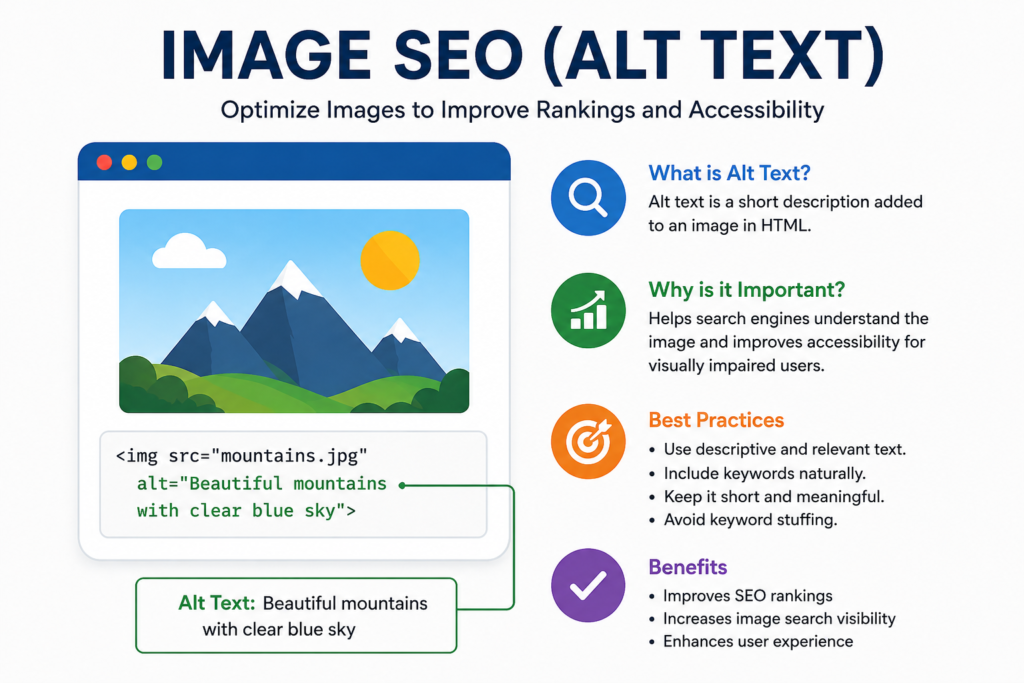
Image SEO (Alt Text)
- Image SEO is the process of optimizing images to improve website performance and search engine rankings. One of the most important parts of Image SEO is using alt text, also known as alternative text.
- Alt text is a short description added to an image in HTML. It helps search engines understand what the image is about and improves accessibility for visually impaired users using screen readers.
- Example:
Alt Text: “Digital marketing team working on SEO strategy” - Good alt text should be descriptive, relevant, and include keywords naturally when appropriate. Avoid keyword stuffing because it can negatively affect SEO. Instead, focus on accurately describing the image content.
- Optimizing image file names, reducing image size, and using modern formats like WebP also improve website speed and user experience. Faster-loading images help reduce bounce rates and improve overall SEO performance.
- Images can also appear in Google Image Search, bringing additional organic traffic to a website. Properly optimized images improve content quality and make webpages more engaging for visitors.
- Image SEO is essential because search engines cannot fully understand images without text-based descriptions. By using clear alt text and optimized image settings, websites can improve accessibility, enhance user experience, and achieve better search engine visibility.
Internal Linking Strategy
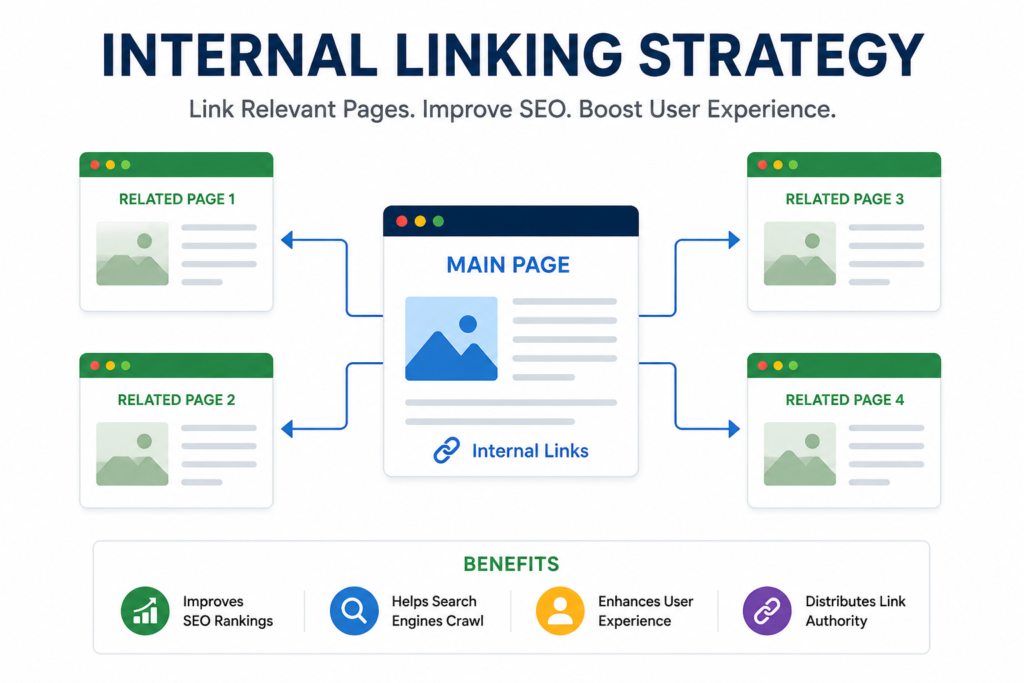
- Internal linking is the practice of connecting one page of a website to another page within the same domain. It helps users navigate a website easily and allows search engines to discover and index pages more effectively.
- A strong internal linking strategy improves website structure and distributes link authority across different pages. For example, a blog about SEO can link to related pages like keyword research, content marketing, or technical SEO services.
- Anchor text, which is the clickable text of a link, should be descriptive and relevant to the linked page. Instead of using generic text like “Click Here,” use meaningful phrases such as “Learn advanced SEO techniques.”
- Internal links help visitors spend more time on a website by guiding them to related content. This reduces bounce rates and improves user engagement. Search engines also use internal links to understand the relationship between webpages and determine which pages are most important.
- Avoid excessive linking because too many links can confuse users and reduce SEO value. Focus on linking relevant pages naturally within the content.
- An effective internal linking strategy improves website navigation, boosts page authority, enhances user experience, and helps search engines crawl websites more efficiently for better rankings.
FAQ – On-Page SEO
1. What is On-Page SEO?
On-Page SEO is the process of optimizing webpage content, titles, images, URLs, and headings to improve search engine rankings and user experience.
2. Why are title tags important in SEO?
Title tags help search engines understand webpage content and attract users to click on search results, improving traffic and rankings.
3. What is the purpose of meta descriptions?
Meta descriptions provide a short summary of a webpage in search results and help increase click-through rates from Google.
4. How do header tags (H1, H2, H3) help SEO?
Header tags organize content properly, improve readability, and help search engines understand webpage structure and topics.
5. Why is internal linking important?
Internal linking connects related pages within a website, improves navigation, helps search engines crawl pages, and increases user engagement.